COMMON QUESTIONS / FURTHER READING
Common Questions
These answers set out CFEJN’s biblical abolitionist position: God calls us to protect every human impartially, seek the abolition of abortion and lethal IVF, and lead people toward repentance in belief and behavior through the Gospel of Jesus Christ.
What gives a human being worth?
Every human being has worth because God made humanity in His image. That worth is given by our Creator; it is not granted by parents, governments, doctors, or public opinion. A human being does not become more deserving of protection by growing larger, developing abilities, being wanted, or moving from the womb to the world outside. Preborn humans bear that same God-given dignity from fertilization.
This truth places a duty on us. Intentionally killing an innocent preborn human is murder, and the child deserves the same basic protection against it as a born neighbor. We must reject laws and practices that treat some humans as disposable. Loving our neighbors includes seeking equal justice for those who cannot speak for themselves.
Faithfulness also requires repentance in our own beliefs and behavior. We must abandon ideas that make human worth negotiable and turn from participating in or excusing that injustice. As we teach this truth, we also proclaim the Gospel: every one of us needs forgiveness and reconciliation to God through Jesus Christ.
Scripture: Genesis 1:27; Proverbs 24:11–12.
Do difficult circumstances change that worth?
No. Hardship changes the help a person needs; it does not remove another human being’s right to life. Poverty, fear, abandonment, disability, or the circumstances of conception cannot make an innocent child deserving of death. A child conceived through rape bears no guilt for the attacker’s crime. The mother deserves protection, care, and justice, and her child deserves protection too.
Godly compassion requires us to act. Churches and neighbors should help with food, housing, transportation, medical care, childcare, and sustained personal support. We should confront fathers who abandon their responsibilities and people who pressure others toward abortion. Our willingness to help must extend beyond a conversation or the day of a child’s birth.
We can be patient with frightened or confused people while being clear that intentionally killing an innocent human is wrong. We should listen carefully, explain the truth, offer practical help, and call people to turn from sinful choices and the beliefs used to justify them. The Gospel gives us reason to seek both the child’s protection and the parent’s reconciliation to God.
Scripture: Leviticus 19:15; Matthew 23:23.
Why pursue immediate, equal protection?
Because God’s commands against murder and partiality require obedience now. Preborn humans already possess the worth that just laws ought to recognize. We therefore seek the abolition of abortion and lethal IVF through laws that protect every human from fertilization and apply an impartial standard of responsibility to those who culpably participate in killing.
Our proposed laws should uphold that standard throughout. Age, size, disability, circumstances of conception, and wantedness must not determine which innocent humans may be intentionally killed. We reject bargaining away the protection of some children as the price of protecting others. God condemns unjust decrees, and good intentions do not make an unjust provision righteous.
Taking steps toward a goal is not, by itself, immoral. Some work necessarily unfolds through a sequence of events: teaching, drafting legislation, introducing a bill, debating it, and voting on it. We acknowledge that procedural reality. But every step must align with God’s nature and His commands. No step may contradict, suspend, or bargain away what God has already said directly and in full. The standard of righteousness applies to each proposed step as well as to the final goal.
This carries particular moral weight when the issue is the murder of innocent humans. Scripture’s condemnation of murder runs from Cain and Abel (Genesis 4:8–12), through God’s words to Noah (Genesis 9:5–6) and His command through Moses (Exodus 20:13), into the New Testament (1 John 3:11–15). We must apply that consistent moral standard to preborn humans. A procedural sequence does not make it righteous to propose exceptions to the protection they are owed.
That rules out even proposing week-based bans that prohibit abortion only after a selected gestational age while leaving younger children without that protection. It also rules out proposing bans with outright legal immunity for a category of culpable participants, including mothers, simply because of their role. Individual guilt, coercion, evidence, and applicable defenses must still be judged justly; a categorical exemption is not the same as that case-by-case judgment. Calling such provisions a temporary step toward abolition does not remove their contradiction of equal justice.
There is a faithful way forward: rescue those we can, support families, teach churches, petition officials, and pursue equal protection through lawful action. This work may require persistence, but the time needed to persuade people does not change what justice requires. We are responsible for obeying God and should entrust the results to Him.
Just laws and Gospel proclamation belong in the same faithful effort. We can work to restrain outward evil while calling people to repent of sinful conduct and false beliefs, trust Christ, and learn to love their neighbors.
Read “Negotiating Evil” for a scenario exploring the difference between rescuing those we can and agreeing to legal permission for the intentional killing of others.
Scripture: Isaiah 10:1–2; Romans 3:8.
Why outlaw lethal IVF methods?
The same human dignity applies in the womb and in the lab. A human embryo is not a disposable product, and the desire to have a child cannot justify intentionally destroying another. Children conceived through IVF have the same worth as every other child. The moral issue is how human beings are treated, not a lesser status for those conceived through a particular method.
By lethal IVF, we mean practices that intentionally destroy human embryos. We call for that killing to be prohibited under the same impartial protection against homicide that should defend every human. Existing embryos must be treated as human lives entrusted to our care, not as unwanted inventory. An unintended loss must be distinguished from intentional destruction; truthful judgment matters here too.
Families facing infertility need compassion and faithful counsel. We should help them examine decisions in light of God’s commands, reject methods that require treating children as expendable, and seek care that respects every life involved. For anyone who has authorized or carried out embryo destruction, our message includes a real call to repentance and real hope of forgiveness through Jesus Christ.
Scripture: Genesis 1:27; Romans 3:8.
How is abolitionism different from incrementalism?
Abolitionism calls for the immediate end of legalized abortion and lethal IVF through equal protection for every human from fertilization. We begin with God’s commands against murder and partiality. Those commands establish what we must seek and what means we may use, even when obedience is costly or politically unpopular.
Incremental approaches commonly pursue restrictions based on gestational age or other conditions while postponing full protection. Our objection is to proposed laws that leave a category of innocent humans legally available for intentional killing or grant a category of culpable participants special immunity. A stated long-term goal of abolition does not make an unjust provision faithful in the present. Romans 3:8 rejects doing evil so that good may result; we apply that principle to the laws we advocate.
Taking steps toward a goal is not, by itself, immoral. Some work necessarily unfolds through a sequence of events: teaching, drafting legislation, introducing a bill, debating it, and voting on it. We acknowledge that procedural reality. But every step must align with God’s nature and His commands. No step may contradict, suspend, or bargain away what God has already said directly and in full. The standard of righteousness applies to each proposed step as well as to the final goal.
This carries particular moral weight when the issue is the murder of innocent humans. Scripture’s condemnation of murder runs from Cain and Abel (Genesis 4:8–12), through God’s words to Noah (Genesis 9:5–6) and His command through Moses (Exodus 20:13), into the New Testament (1 John 3:11–15). We must apply that consistent moral standard to preborn humans. A procedural sequence does not make it righteous to propose exceptions to the protection they are owed.
That rules out even proposing week-based bans that prohibit abortion only after a selected gestational age while leaving younger children without that protection. It also rules out proposing bans with outright legal immunity for a category of culpable participants, including mothers, simply because of their role. Individual guilt, coercion, evidence, and applicable defenses must still be judged justly; a categorical exemption is not the same as that case-by-case judgment. Calling such provisions a temporary step toward abolition does not remove their contradiction of equal justice.
We should rescue children, help families, educate neighbors, and pursue just laws wherever we can. We do not have to accomplish every task everywhere at once before doing anything. Limited resources and the time needed to accomplish a task do not require us to endorse a lesser moral standard. The question is whether each action itself is just and consistent with equal protection.
We should call fellow Christians to examine both their methods and their beliefs before God, with patience and clear reasoning. Repentance includes turning from compromises and excuses we have defended. We can pursue faithful action now, invite others to join it, and proclaim the Gospel while trusting God with the results.
Read “Negotiating Evil” for a scenario exploring the difference between rescuing those we can and agreeing to legal permission for the intentional killing of others.
Scripture: Leviticus 19:15; Isaiah 10:1–2; Romans 3:8.
Are you saying we shouldn’t take individual steps toward the goal of abolishing abortion?
No. CFEJN is not generally against taking individual steps or doing things in a sequential order. One thing happening and then another thing happening is not automatically wrong. Our objection concerns what each step proposes, permits, or does.
Every step must follow what God has already said and must not contradict His commands and patterns. We must never go backward on what God has already said directly and completely. Obedience applies to the means we use as well as the goal we seek.
In anything we propose or enact, we cannot increase or permit the act of murder itself or make legal provision for it. Especially, we cannot permit murder or exempt culpable perpetrators from proper justice based on the status or attributes of the victim or perpetrator, such as the child’s stage of development or the perpetrator’s being a mother.
We can help one struggling family today and another tomorrow. We can pray outside abortion clinics. We can pursue bans on particular abortion tools and sources of abortion funding one at a time, provided each proposal itself follows God’s commands and does not authorize killing or create unjust exemptions. We can convince one politician today and another tomorrow. We can work in one jurisdiction while also working in another at the same time. None of these actions requires us to compromise the standard of equal justice.
But we cannot propose or enact a law such as a 20-week abortion ban that permits the killing of younger children, or a law granting outright legal immunity to mothers who culpably kill their babies. Calling such a provision a step toward abolition does not make it consistent with God’s commands. Each person’s guilt, evidence, coercion, and applicable defenses must be judged justly; that is different from categorical immunity based on being a mother.
The distinction is between doing faithful work over time and writing permission for murder or partiality into the steps themselves. We should do the good we can today while continuing to seek complete abolition and equal protection for every human.
Read “Negotiating Evil” for more on faithful means and the goal of saving lives.
Does equal justice mean everyone receives the same punishment?
No. Equal justice means an impartial standard of protection and accountability, with each person’s responsibility judged truthfully. It does not mean identical verdicts or penalties regardless of the facts. Protecting preborn humans equally requires taking both their lives and the rights of accused people seriously.
We advocate applying homicide law impartially to the culpable killing of preborn humans. A mother, father, physician, abortion provider, or other participant should not receive automatic immunity merely because of that role. Neither should anyone be presumed guilty because of a pregnancy loss or association with a particular medical procedure. Intent, conduct, evidence, coercion, and applicable defenses must be considered in each individual case, with due process and the burden of proof resting on the prosecution.
God’s command against partiality concerns the victim and the accused. We should oppose both laws that deny children protection and accusations that outrun the evidence. A miscarriage or unintended death is not, by itself, proof of a crime. An abolitionist standard calls for truthful, proportionate justice through lawful authorities, not personal vengeance.
The Gospel remains central. We can call a culpable person to stop doing evil, reject the beliefs used to justify it, and seek forgiveness in Christ. Forgiveness before God and accountability before civil authorities can both be real. We do not need to deny wrongdoing in order to offer mercy, patient counsel, and practical care.
Scripture: Leviticus 19:15; Romans 13:1–4.
Is every embryo lost during IVF intentionally killed?
No. An unintended death and the deliberate destruction of a human embryo are morally different. Equal justice requires us to tell the truth about what happened. We must not assume that every failed implantation or embryo loss proves intentional killing, and we must not use natural mortality to excuse deliberately destroying a child.
Our opposition to lethal IVF concerns practices that intentionally discard or destroy human embryos, including destruction because an embryo is unwanted or selected for destructive research. Human worth does not depend on usefulness, health, or whether someone plans to bring that child to birth. A laboratory setting does not change the duty to protect human life.
Intentional killing, reckless or negligent treatment, and an unavoidable loss require careful factual distinctions. Those distinctions should be assessed through an impartial standard, not blurred to excuse wrongdoing or manufacture guilt. Our demand is that human embryos receive protection and care consistent with their humanity, and that culpable destruction be addressed through equal justice.
There is a faithful response for families and professionals: refuse to authorize intentional destruction, seek informed care for existing embryos, and examine practices honestly before God. Where someone has participated in wrongdoing, repentance includes changing the conduct and abandoning the belief that another human may be treated as disposable. The church should help people make those changes and point them to forgiveness and new life in Christ.
Scripture: Genesis 1:27; Leviticus 19:15.
What about difficult pregnancies and infertility?
Both the mother and her child have God-given worth, and both deserve serious care. Fear, poverty, abandonment, disability, and infertility can bring profound suffering. Our duty is to respond with truth, compassion, and practical help while refusing to treat an innocent human as expendable. Suffering does not give us permission to commit an injustice against someone else.
A dangerous pregnancy requires prompt assessment and treatment by qualified medical professionals. Women must receive necessary emergency and miscarriage care. Our moral opposition to the intentional killing of innocent humans must not be used to withhold lifesaving treatment or to treat every tragic loss as murder. Accurate medical facts, the purpose of treatment, and the circumstances matter; a short slogan cannot determine a patient’s care.
For infertility, a sincere desire for a child does not justify intentionally destroying other children. Families should receive honest information and support in seeking options consistent with protecting every human involved. Existing embryos also deserve thoughtful, responsible care. We should never imply that an infertile person’s worth, faithfulness, or place in the church depends on becoming a parent.
Faithfulness has a practical form: accompany people through appointments and grief, help with material needs, involve trustworthy pastoral support, and remain present when circumstances stay difficult. We should offer this care freely while inviting people to turn from sinful choices and false beliefs and to trust Christ. Compassion and a clear call to repentance can be expressed together.
Scripture: Matthew 23:23; 2 Timothy 2:24–26.
Is there hope for someone involved in abortion or embryo destruction?
Yes. There is real forgiveness and reconciliation to God through Jesus Christ. We must speak honestly about the gravity of intentionally killing an innocent human, and we must speak just as clearly about the sufficiency of Christ for sinners who turn to Him. Concealing sin leaves people with a false peace; the Gospel offers genuine hope.
The eternal Son of God became truly human, lived without sin, died for our sins, was buried, and rose bodily from the dead. Salvation is God’s gift of grace through faith in Christ. It is not earned by activism, a correct position on abortion, or enough good deeds to compensate for the past. Someone who has always opposed abortion still needs the same Savior.
Jesus calls us to repent and believe the Gospel. That includes a change of mind and allegiance: giving up self-justification, rejecting false beliefs about God and our neighbors, and trusting Christ rather than our own righteousness. It also bears fruit in conduct: stopping participation in wrongdoing, refusing to excuse it, and learning to protect and love others. Changed behavior flows from faith; it does not purchase forgiveness.
Those who have participated in abortion or embryo destruction should be met with truthful, patient, personal care. We should help them seek sound Christian counsel, learn Scripture, and take responsible steps of obedience. Repentance does not erase every earthly consequence, but the past need not be defended, repeated, or treated as beyond Christ’s mercy. Our invitation is to come to Him and walk in newness of life.
Scripture: 1 Corinthians 15:3–4; Mark 1:15; Ephesians 2:8–10; 1 John 1:9.
What does living out this conviction look like?
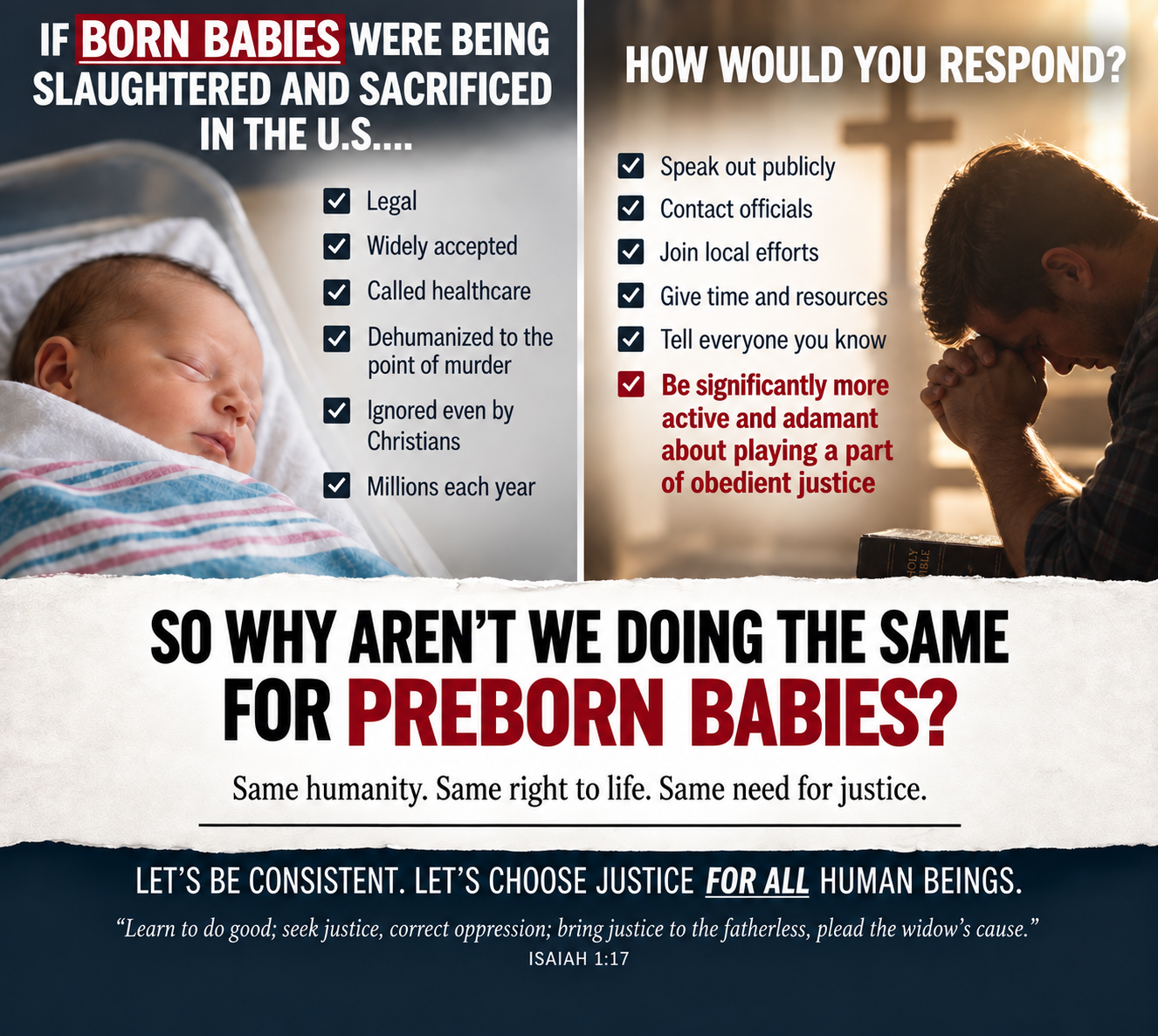
It means obeying God in both what we seek and how we pursue it. The duty to love our neighbors, reject partiality, and rescue those in danger belongs to Christians. We do not need a special calling before those commands apply. Our opportunities and responsibilities differ, but indifference to the killing of vulnerable humans is not a faithful response.
Begin with repentance and study: examine your own conduct, the ideas you repeat, and the practices or policies you support. Then take concrete steps. Teach Scripture in your church, speak truthfully in public, contact government officials, advocate laws that establish equal protection, support abolitionist efforts, and help families with practical needs. Take responsibility for work you can sustain instead of waiting for ideal conditions.
Our conduct should be lawful, peaceful, courageous, and truthful. We should listen, answer objections carefully, refuse threats or harassment, and correct false claims even when they might seem useful to our cause. The person we address is also a neighbor made in God’s image. Firm moral clarity and patience with people belong together.
Keep the Gospel explicit. Ask people to turn from sinful behavior and the beliefs that excuse it, and explain their need for Christ’s saving work. Scripture directs the Lord’s servants to teach with gentleness, trusting God to grant repentance. Laws can restrain wrongdoing, but we must also proclaim the truth through which people are called to faith.
We are responsible for faithful obedience, not for controlling every outcome. We can pursue abolition now, care for the people before us, pray, persevere, and trust God with the growth. The aim is protection for our vulnerable neighbors and lives increasingly shaped by repentance, faith, justice, and mercy.
Scripture: Proverbs 24:11–12; 2 Timothy 2:24–26; Ephesians 2:8–10.